

Facts & figures
British apple and pear industry statistics
British Apples & Pears Limited (BAPL) is the industry body representing commercial apple and pear growers in the UK.
We collect and publish data on British apple and pear production, orchards, varieties, supermarket sales and the economics of growing apples and pears in Britain.
This page brings together key statistics about the British apple and pear industry, drawing on data collected directly from BAPL growers, BAPL’s Orchard and Storage Census, independent research commissioned by BAPL and other recognised industry sources.
British apples and pears at a glance
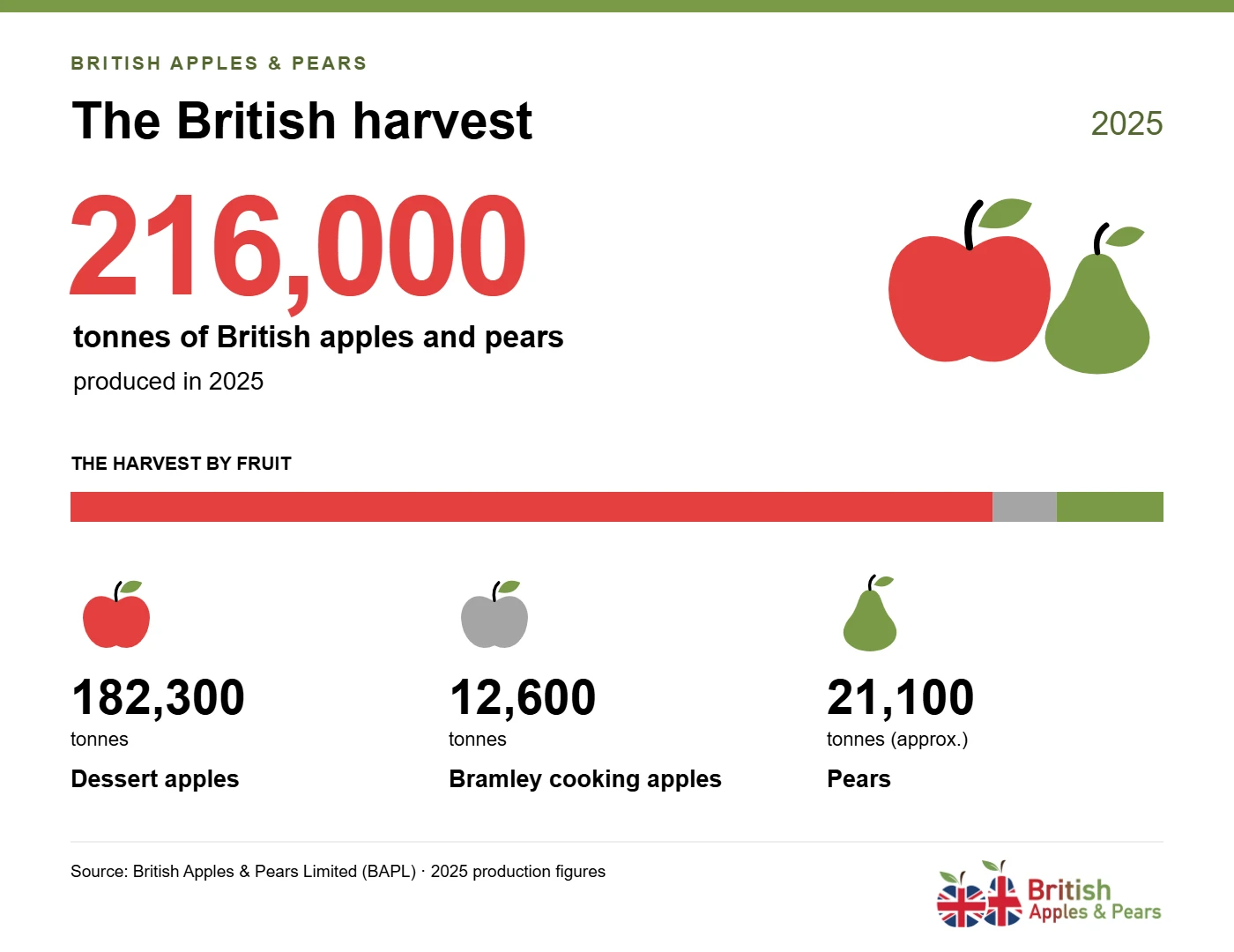
216,000 tonnes
of British apples and pears produced in 2025
1.5 billion
British dessert apples produced in 2025
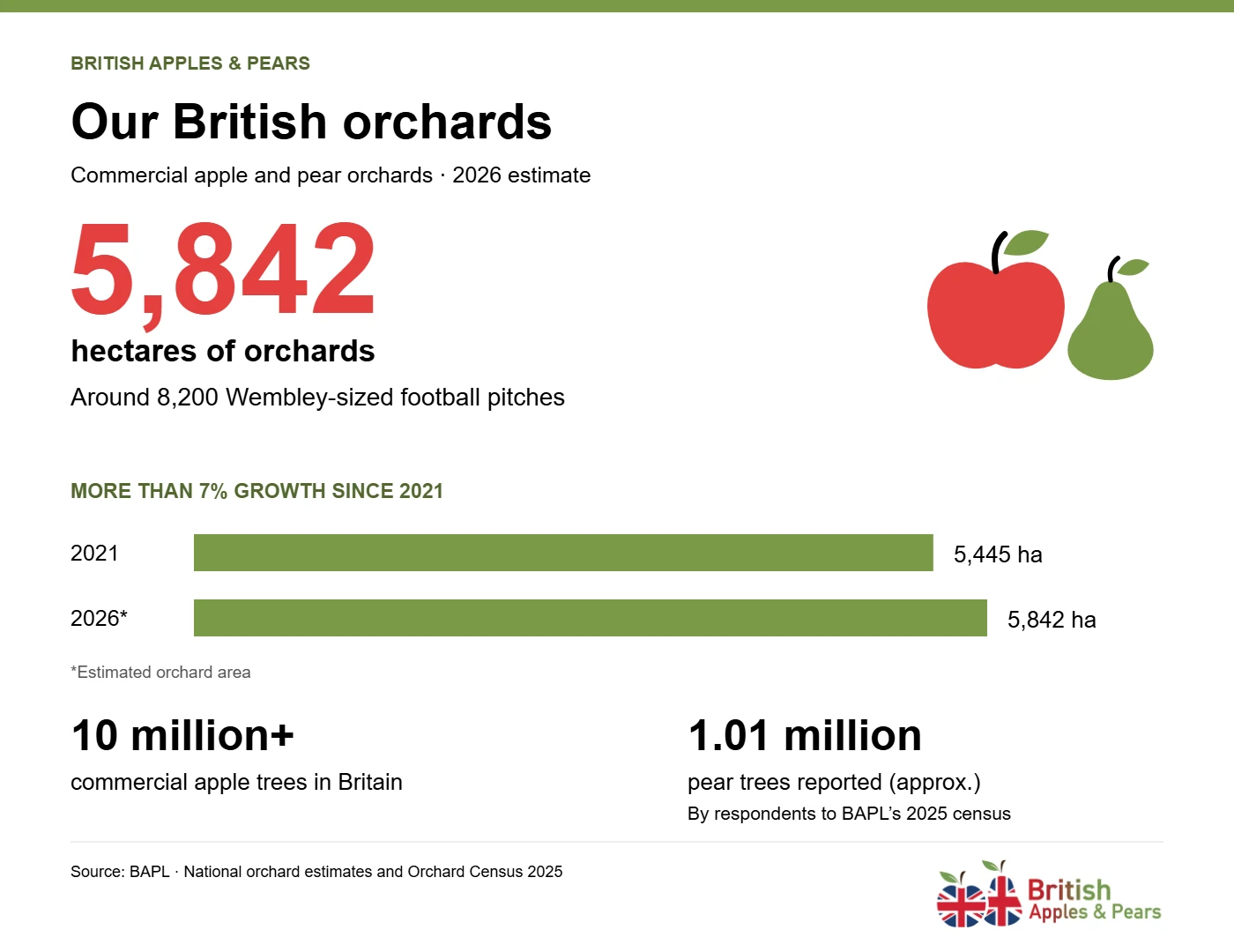
5,842 hectares
of commercial apple and pear orchards in 2026 – around 8,200 Wembley-sized football pitches
10 million+
commercial apple trees in Britain
70 varieties
of apples grown commercially in Britain
197,271 tonnes
of apple and pear storage capacity identified by BAPL’s 2025 census
Production
British apple and pear production
British growers produced 216,000 tonnes of apples and pears in 2025.
British apple production
- British growers produced 194,900 tonnes of apples in 2025, comprising 182,300 tonnes of dessert apples and 12,600 tonnes of Bramley cooking apples.
- 1.5 billion estimated British dessert apples produced
- Around 26 million dessert apples are picked each day during the eight-week harvest.
Read the annual apple production data →
British pear production
British growers produced approximately 21,100 tonnes of pears in 2025.
Source: British Apples & Pears Limited (BAPL), 2025 production figures↓ Download infographic
Orchards
British apple and pear orchards
Britain has an estimated 5,842 hectares of commercial apple and pear orchards in 2026 – equivalent to around 8,200 football pitches.
The area devoted to commercial apple and pear production has increased in recent years. Orchard hectarage has grown from 5,445 hectares in 2021 to an estimated 5,842 hectares in 2026, an increase of more than 7%.
| 2021 | 2022 | 2023 | 2024 | 2025 | 2026* |
|---|---|---|---|---|---|
| 5,445 | 5,343 | 5,216 | 5,598 | 5,692 | 5,842 |
*Estimated orchard area
The figures below come from BAPL’s 2025 Orchard and Storage Census and describe the orchards reported by survey respondents. They are not a breakdown of the national 2026 estimate above.
Apple orchards and trees
There are more than 10 million commercial apple trees in Britain, growing around 70 different apple varieties.
Among respondents to BAPL’s 2025 census, Kent had the largest apple orchard area, with 3,387 hectares, followed by Herefordshire with 280 hectares. Apple orchards in other counties also contributed to the survey total.
1,066 hectares of apple orchards have been planted in the five years up to 2025, averaging 213 hectares a year.
Pear orchards and trees
Respondents to BAPL’s 2025 census reported approximately 1.01 million commercial pear trees across 702 hectares of orchards.
Source: BAPL national orchard estimates and Orchard and Storage Census 2025↓ Download infographic
Varieties
British apple and pear varieties
British apple varieties
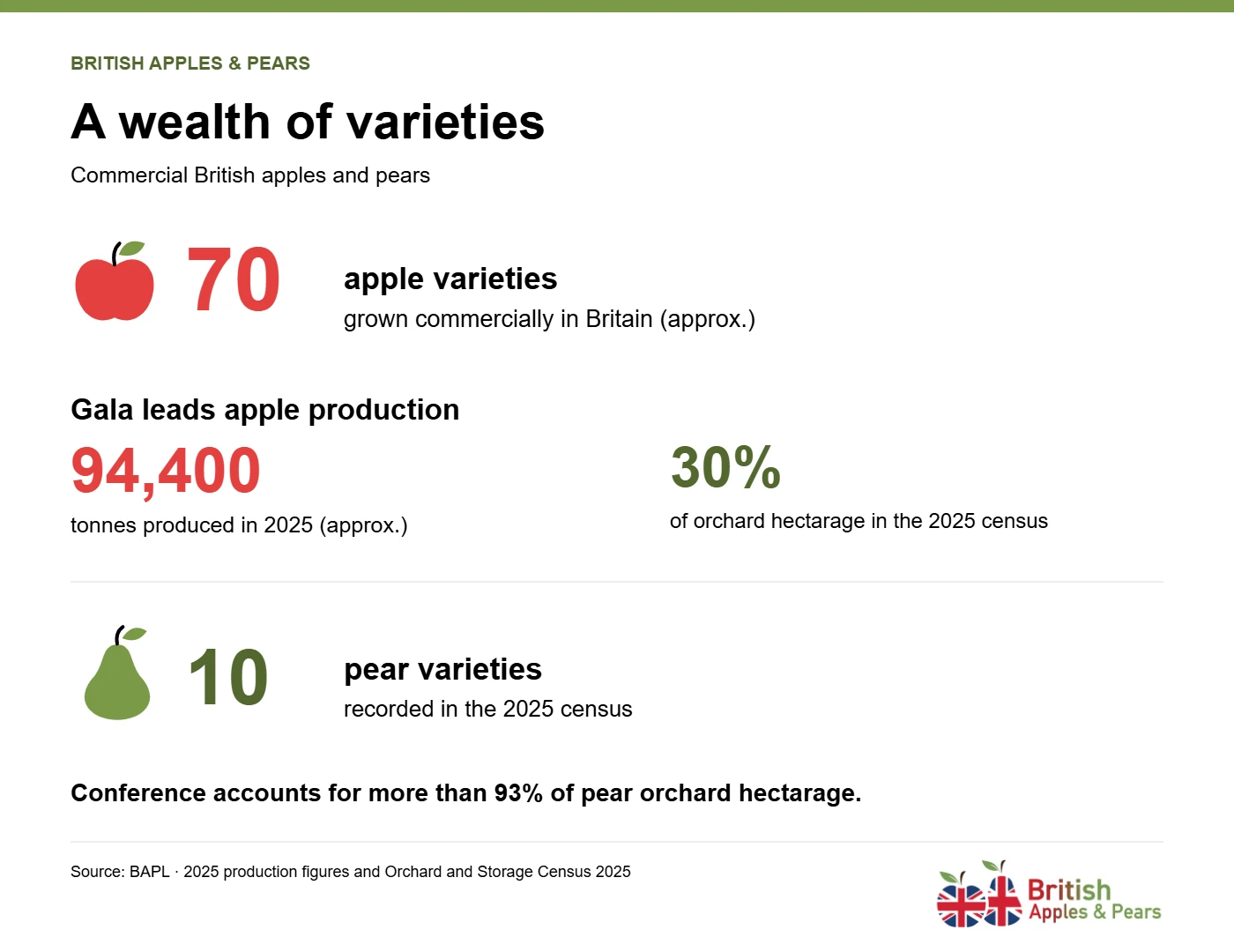
Around 70 apple varieties are grown commercially in Britain.
The major varieties grown by British commercial growers include:
Gala was Britain’s largest apple variety by production volume in 2025, with British growers producing approximately 94,400 tonnes.
Gala accounted for 30% of orchard hectarage in the 2025 census; the survey recorded more than 4 million Gala trees.
Other dessert apples include Magic Star, Pink Lady, Red Windsor, Red Price, Smitten, Junami and more.
Explore British apple varietiesView apple production by variety
British pear varieties
Ten commercial pear varieties were recorded in BAPL’s 2025 census. Conference is by far Britain’s dominant pear variety, accounting for more than 93% of pear orchard hectarage, with 953,334 Conference trees recorded.
Explore British pear varietiesView pear production by variety
Source: BAPL 2025 production figures and Orchard and Storage Census 2025↓ Download infographic
Supermarket sales
British apples and pears in UK supermarkets
BAPL collects supermarket sales data directly from its grower members throughout the British apple and pear season. The data is published monthly on the BAPL website.
View monthly British apple sales dataView monthly British pear sales data
The data records the volume of British apples and pears supplied to the UK’s major supermarkets and allows BAPL to track both the overall performance of British fruit and individual retailers’ support for British growers.
British apple supermarket sales
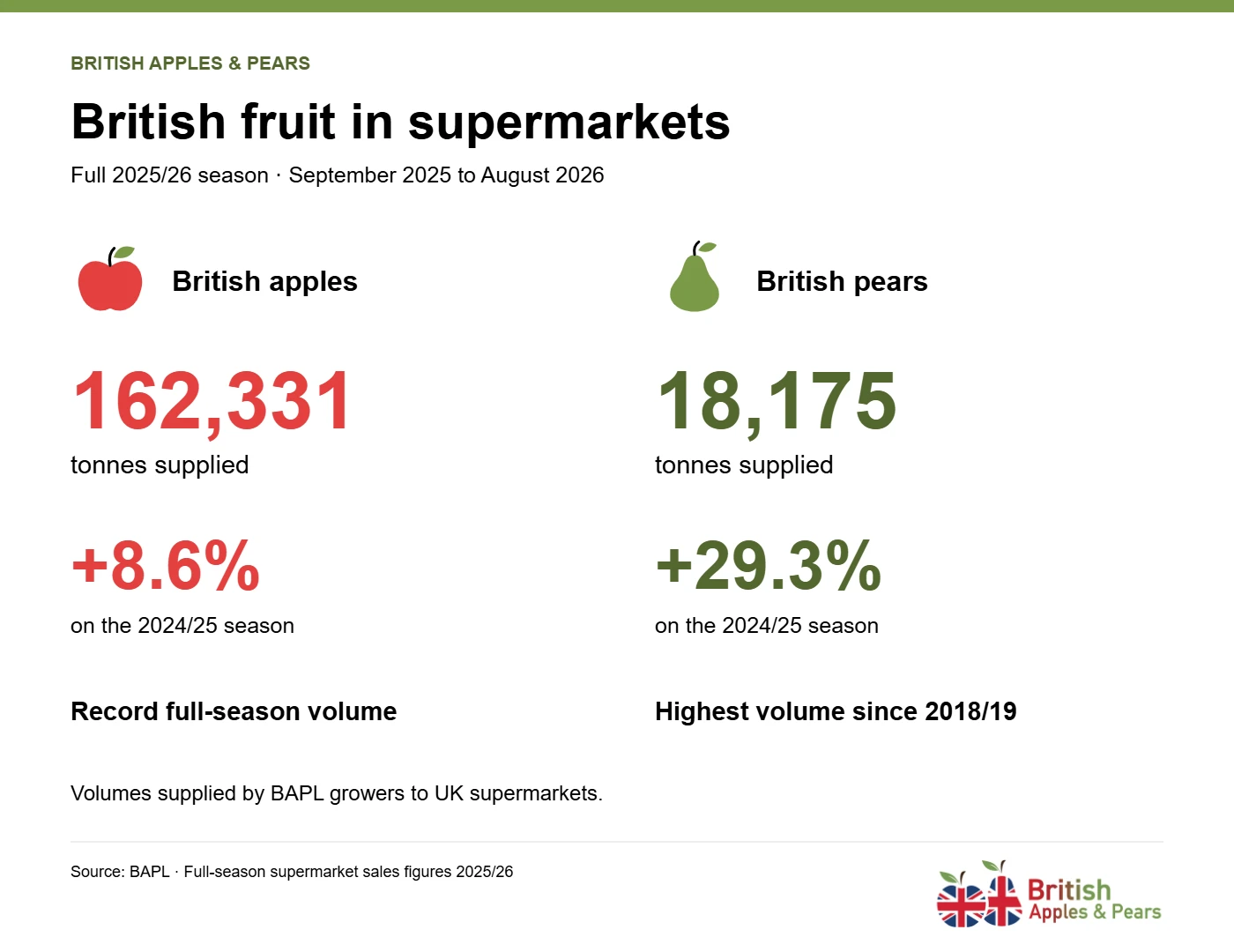
In the full 2025/26 season, from September 2025 to August 2026, BAPL growers supplied a record 162,331 tonnes of British apples to UK supermarkets.
This was an increase of 8.6% on the 2024/25 season.
Read the full-season resultsView the latest British apple sales data
British pear supermarket sales
BAPL also tracks the volume of British pears supplied to UK supermarkets.
In the 2025/26 season, BAPL growers supplied 18,175 tonnes of British pears to UK supermarkets, an increase of 29.3% on 2024/25 and the highest volume since 2018/19.
Read the full-season resultsView the latest British pear supermarket sales data
British share of the UK apple market
Despite Britain’s strong apple-growing conditions and established commercial growing industry, the UK continues to import a substantial proportion of the apples it consumes.
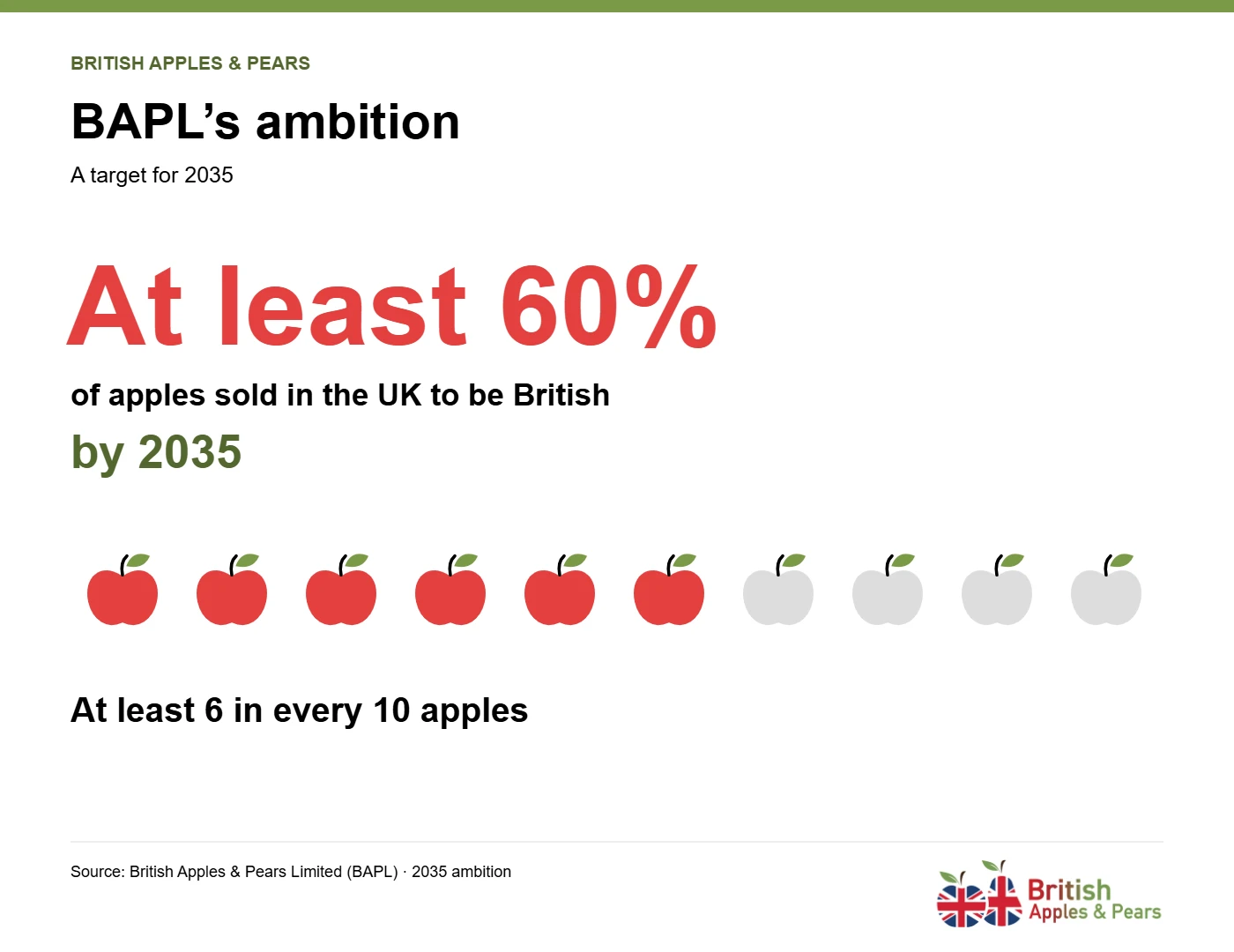
BAPL’s ambition is for at least 60% of the apples sold in the UK to be British by 2035.
BAPL also publishes monthly retailer league tables, comparing each major supermarket’s share of British apple and pear sales. For apples, BAPL compares retailers’ share of British apple sales with their overall grocery market share, providing an indication of their relative support for British-grown fruit.
View the latest British apple sales dataView the latest British pear supermarket sales data
Source: BAPL full-season supermarket sales figures 2025/26↓ Download sales infographic↓ Download 2035 ambition infographic
Storage
British apple and pear storage
Modern storage technology enables British apples and pears to be available throughout the year, long after the main autumn harvest.
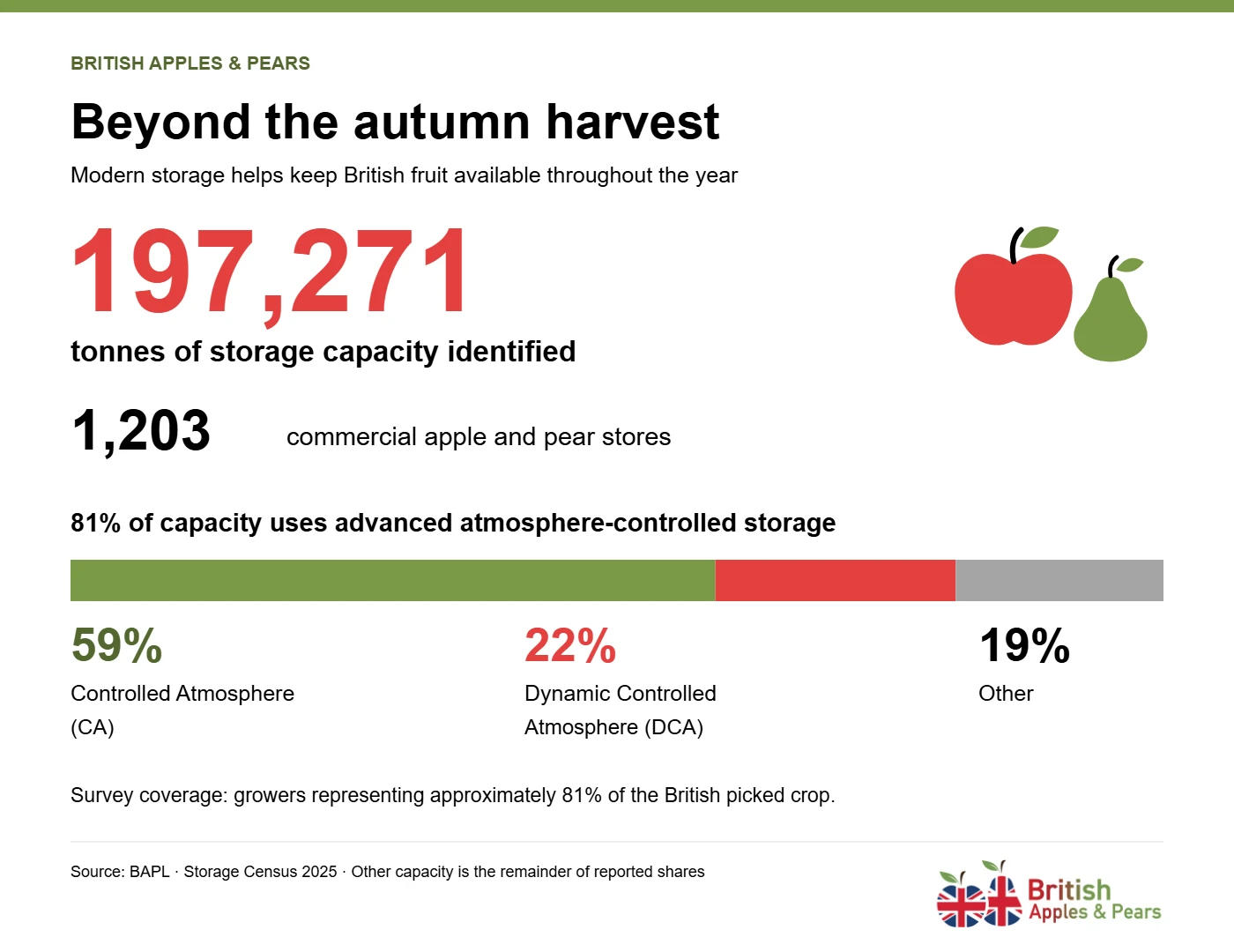
BAPL’s 2025 Storage Census identified 1,203 commercial apple and pear stores with a combined storage capacity of 197,271 tonnes. The survey covered growers representing approximately 81% of the total British picked crop.
More than four-fifths of this capacity uses advanced atmosphere-controlled storage. Controlled Atmosphere (CA) storage accounts for 59% of capacity, with Dynamic Controlled Atmosphere (DCA) providing a further 22%. These technologies slow the natural maturation of fruit after harvest, helping maintain its quality for many months.
Source: BAPL Storage Census 2025↓ Download infographic
Cost of production
The cost of growing British apples
BAPL commissions independent annual analysis from Andersons Midlands to track changes in the cost of producing British apples.
The analysis is based on detailed cost information from a panel of commercial British apple growers. For the 2026 Gala analysis, participating growers represented more than 60% of total UK Gala production, providing a robust and representative picture of cost pressures across the industry.
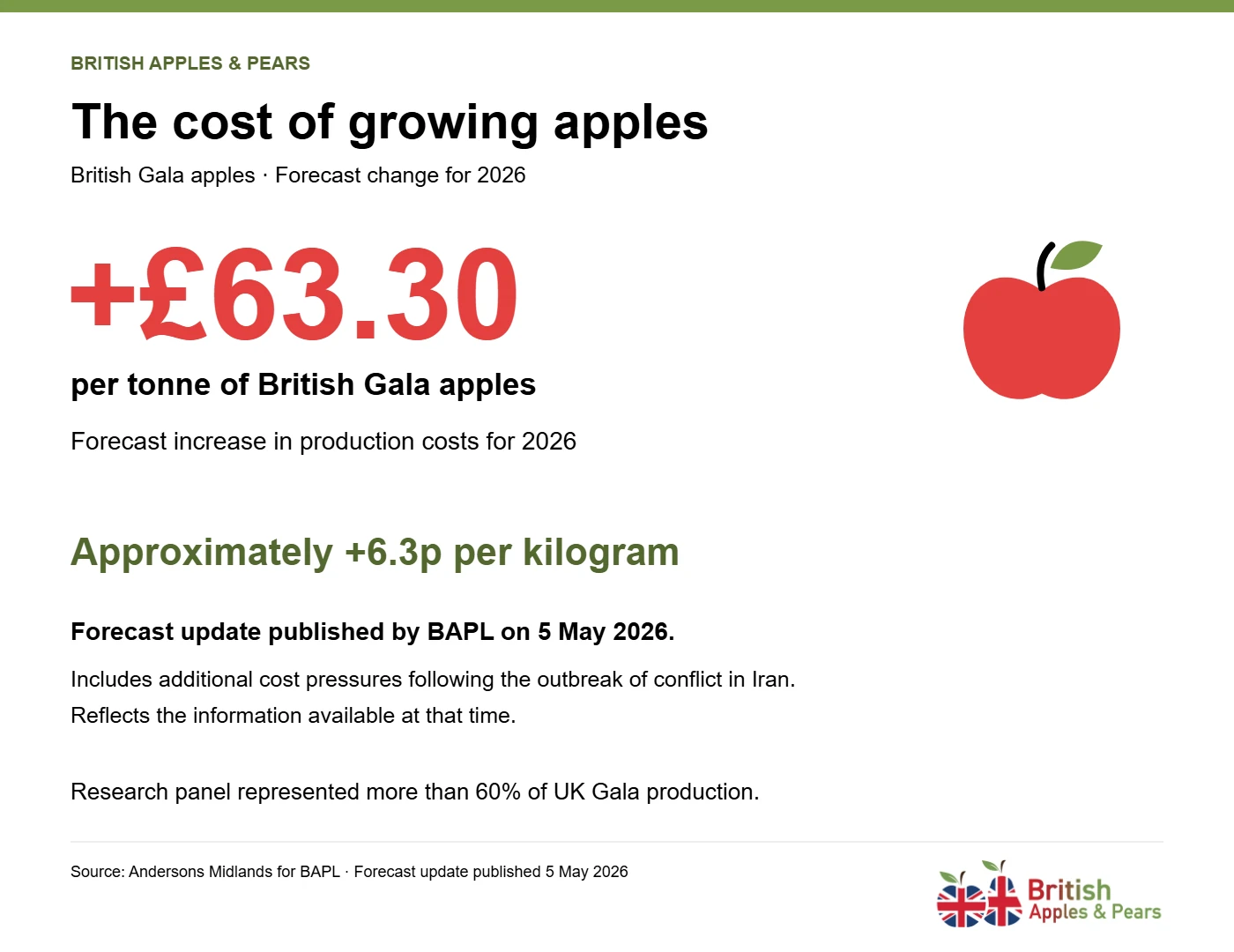
An update to Andersons Midlands’ analysis, published by BAPL on 5 May 2026, forecast that British Gala apple production costs would increase by £63.30 per tonne in 2026, equivalent to approximately 6.3 pence per kilogram. This included the additional cost pressures identified following the outbreak of the conflict in Iran and reflected the information available at that time. The analysis takes account of all major costs involved in commercial apple production.
BAPL uses this independent analysis to track how the costs of British apple production are changing over time. Detailed individual cost benchmarks are not published because they contain commercially sensitive information.
Source: Andersons Midlands for BAPL, forecast update published 5 May 2026↓ Download infographic
Methodology & sources
About BAPL’s industry data
BAPL’s Orchard and Storage Census is one of the most comprehensive datasets on Britain’s commercial apple and pear industry. Respondents to the 2025 orchard census represented 92% of the annual picked crop sold to UK supermarkets and other major retailers, while storage survey respondents represented 81%.
BAPL collects industry data directly from its grower members and commissions independent research into the economics and structure of British apple and pear production.
Where statistics on this page come from external datasets or commissioned independent research, the source is identified alongside the relevant information.
BAPL’s data includes:
- Monthly British apple supermarket sales
- Monthly British pear supermarket sales
- Annual production by variety
- Commercial orchard hectarage
- Apple and pear tree numbers
- Planting intentions
- Storage capacity
- The cost of apple and pear production.
Using BAPL data
Journalists, researchers, policymakers, retailers and other organisations are welcome to use and cite statistics published by British Apples & Pears Limited.
For media enquiries or requests for additional industry data, please contact BAPL.
Please cite the source as British Apples & Pears Limited (BAPL) and, where relevant, include the year of the dataset or research.
BAPL data and research
British apple supermarket sales data
Monthly volumes of British apples supplied by BAPL growers to UK supermarkets, including individual retailer performance.
British pear supermarket sales data
Monthly volumes of British pears supplied by BAPL growers to UK supermarkets.
British apple production data
Annual British apple production figures, including production by major variety.
BAPL Orchard and Storage Census
Data on commercial orchard area, tree numbers, varieties, planting intentions and storage capacity.
Cost-of-production research
Independent analysis of the changing cost of producing British apples and pears.